

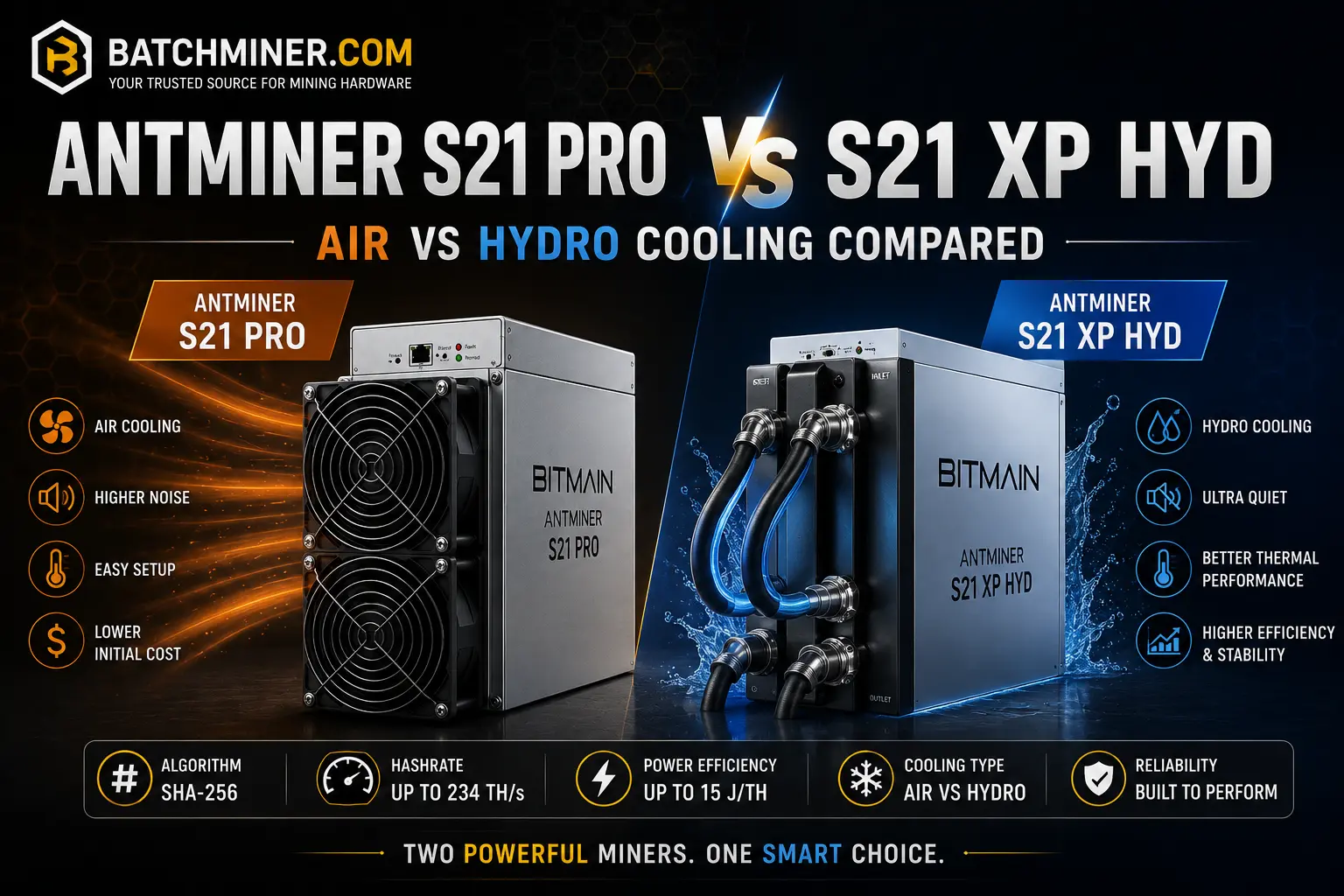
The Antminer S21 Pro vs S21 XP Hyd decision comes down to one core question: is the leap from air cooling to hydro cooling worth the added complexity? Both are current-generation Bitmain Bitcoin miners, but they’re built for genuinely different deployment situations, one plugs into a wall outlet, the other needs plumbing. Here’s the real comparison.
Specifications Side by Side
| Antminer S21 Pro | Antminer S21 XP Hyd | |
|---|---|---|
| Hashrate | 234 TH/s | 473 TH/s |
| Power Consumption | 3,510W | 5,676W |
| Efficiency | 15 J/TH | 12 J/TH |
| Cooling | Air (standard fans) | Hydro (liquid cooling) |
| Noise Level | ~75–80 dB (typical for air-cooled Antminers) | ~50 dB |
| Power Requirement | Standard single-phase | 3-phase AC, 380–415V |
| Additional Infrastructure | None | Coolant Distribution Unit (CDU) required |
The Core Tradeoff: More Hashrate and Efficiency, at a Real Infrastructure Cost
The S21 XP Hyd roughly doubles the S21 Pro’s hashrate (473 vs. 234 TH/s) while running about 20% more efficiently (12 J/TH vs. 15 J/TH). On paper, that looks like a clear win. In practice, the catch is what it takes to actually run one: the XP Hyd requires 3-phase industrial power and a coolant distribution unit, this isn’t something you plug into a household outlet. The S21 Pro, by contrast, is genuinely plug-and-play on standard infrastructure.
Noise: The Difference That Actually Changes Where You Can Put It
This is where hydro cooling makes its strongest case. At roughly 50 dB, the S21 XP Hyd is dramatically quieter than the S21 Pro’s 75–80 dB air-cooled range, the difference between a running refrigerator and a loud vacuum cleaner. If noise is what’s kept you from running Bitcoin ASICs somewhere noise-sensitive, hydro cooling is the actual solution, not a marginal improvement.
Who the S21 Pro Is Actually For
- Home miners and small operators without existing hydro infrastructure
- Anyone who wants to start mining without building a water-cooling loop from scratch
- Buyers prioritizing lower upfront cost per unit and zero plumbing complexity
- First-time miners building operational experience before scaling up
Who the S21 XP Hyd Is Actually For
- Operators scaling beyond a handful of units, where density and efficiency gains compound
- Facilities with access to cheap electricity and already-built or planned hydro infrastructure
- Noise-restricted deployments where air-cooled ASICs simply aren’t allowed
- Heat-recovery setups, where the water loop can double as a heating source
Who should skip the XP Hyd: anyone adding just one or two units to an existing air-cooled setup, or without single-phase-to-3-phase power already sorted, the cost of building a water-cooling loop from scratch for a small deployment rarely pencils out.
Real Cost Comparison
At the national average electricity rate (~18¢/kWh):
- S21 Pro (3,510W): ~$15.16/day (~$455/month)
- S21 XP Hyd (5,676W): ~$24.52/day (~$736/month)
The XP Hyd costs more to run in absolute terms, but produces double the hashrate, so the real comparison is revenue per dollar of electricity, not just the sticker cost. Run both through a live calculator like WhatToMine against your actual rate before deciding, since the better efficiency (12 vs. 15 J/TH) needs to outweigh the higher absolute draw for the XP Hyd to actually win on your numbers.
Bottom Line
If you’re mining as a home operator or scaling gradually, the S21 Pro remains the practical, lower-friction choice. If you’re building or already operating hydro infrastructure at scale, the S21 XP Hyd’s efficiency and density advantages become real operational savings, not just a spec sheet win. For a deeper look at how efficiency plays out on a different Bitmain miner, see our Antminer Z15 Pro profitability review, or check our full brand comparison if you’re still weighing Bitmain against other manufacturers entirely.
FAQ
Is the Antminer S21 XP Hyd worth the extra cost over the S21 Pro?
It depends on scale and existing infrastructure. For a handful of units without hydro setup already in place, the S21 Pro is more practical. For larger operations with hydro infrastructure or cheap electricity, the XP Hyd’s efficiency gains compound into real savings.
How much quieter is the S21 XP Hyd than the S21 Pro?
Significantly roughly 50 dB for the XP Hyd versus 75–80 dB for the air-cooled S21 Pro, a difference comparable to a refrigerator versus a loud vacuum cleaner.
Can I run an Antminer S21 XP Hyd on standard home power?
No it requires 3-phase AC power (380–415V) and a coolant distribution unit, making it unsuitable for typical residential setups without significant infrastructure investment.
Which is more profitable, the S21 Pro or the S21 XP Hyd?
The XP Hyd produces roughly double the hashrate at better efficiency, but costs more to run in absolute terms and requires added infrastructure. Run both through a live profitability calculator against your actual electricity rate to compare accurately.