


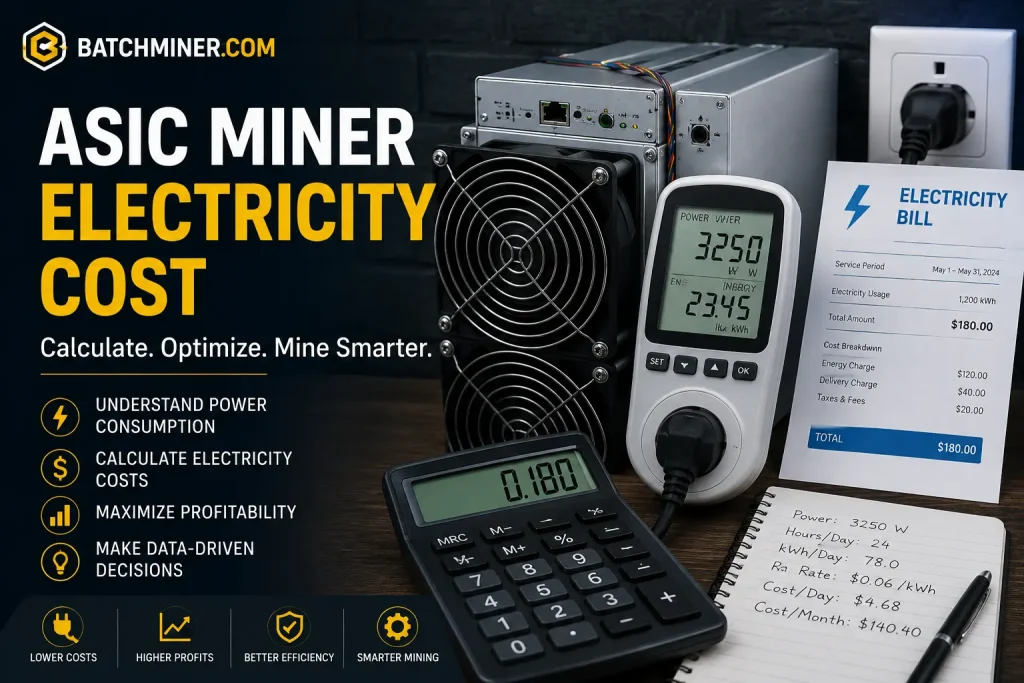
Your ASIC miner electricity cost is the single biggest factor in whether your mining operation turns a profit or a loss — more than coin price, more than network difficulty, because it’s the one variable entirely within your control. This guide shows you exactly how to calculate your ASIC miner electricity cost for any model, at any electricity rate, plus real worked examples using current-generation hardware.
The Formula
Daily electricity cost = (Power draw in Watts ÷ 1000) × 24 hours × your $/kWh rateThat’s the entire calculation — the rest is just plugging in real numbers. Power draw is listed on every miner’s spec sheet, and your electricity rate is on your utility bill (or your local average, if you haven’t checked lately).
What Electricity Actually Costs in the US Right Now (2026)
Rates vary enormously by state, which is exactly why your ASIC miner electricity cost can look completely different from someone else’s running the identical machine:
- National residential average: ~18¢/kWh (per EIA data)
- National commercial average: ~13.5¢/kWh
- Cheapest states (North Dakota, Utah, Washington, Wyoming): 7–12¢/kWh
- Most expensive (Hawaii): 40–52¢/kWh
That’s roughly a 7x difference between the cheapest and most expensive states — which means the exact same miner can be strongly profitable in one location and barely break even in another. This is why we build our own facility decisions around low-cost power: see current live electricity rates by state if you want to check where yours falls.
Worked Examples: ASIC Miner Electricity Cost by Model
Here’s what daily electricity cost actually looks like across current-generation hardware, at different rate tiers:
Antminer Z15 — 420 KSol/s, 1,510W:
- At 10¢/kWh: $3.62/day
- At 18¢/kWh (national average): $6.52/day
- At 40¢/kWh (Hawaii-tier): $14.50/day
Antminer Z15 Pro — 840 KSol/s, 2,780W (roughly double the Z15’s hashrate, at a better 3.15 J/KSol efficiency vs. the standard Z15’s 3.6):
- At 10¢/kWh: $6.67/day
- At 18¢/kWh: $12.01/day
- At 40¢/kWh: $26.69/day
We’ve broken down the full Z15 vs. Z15 Pro decision separately if you’re weighing which makes more sense for your electricity rate.
Antminer S21 Pro — 234 TH/s, 3,510W (15 J/TH), for scale on the Bitcoin side:
- At 10¢/kWh: $8.42/day
- At 18¢/kWh: $15.16/day
- At 40¢/kWh: $33.70/day
Notice the pattern: as hashrate and power draw scale up across a product line, the dollar gap in ASIC miner electricity cost between a cheap-power and expensive-power location scales up right alongside it. The Z15 Pro’s higher efficiency (3.15 vs. 3.6 J/KSol) partly offsets its much larger power draw compared to the standard Z15, but only partly — at every rate tier, running it still costs meaningfully more per day in absolute terms, so the right choice comes down to whether the extra hashrate outpaces that extra cost at current network difficulty.
Why We Don’t Post Fixed “Daily Profit” Numbers
You’ll see some listings advertise a specific dollar profit per day. Be skeptical of these — coin price and network difficulty both shift daily, and a number that was accurate the day it was posted can be meaningfully wrong within weeks. Your ASIC miner electricity cost is the more stable half of the equation, which is why we’d rather show you the formula than a number that goes stale. For a real-time revenue estimate to pair with your own electricity cost, mining calculators like WhatToMine update continuously with current coin prices and network difficulty — combine that revenue figure with your actual electricity cost above for the most accurate picture of your specific situation.
If you’re evaluating a specific unit, like the iBeLink BM-K1+, run its listed power draw through the formula above with your own rate rather than relying on a static profit figure from any listing, including ours.
The Bottom Line
Your ASIC miner electricity cost is the one variable in mining profitability that’s entirely within your control — you can’t influence coin price or network difficulty, but you can choose efficient hardware and, if you have the flexibility, mine where power is cheap. A $200 difference in monthly electricity cost between two locations can be the difference between a mining operation that pays for itself in a year and one that never quite does.
FAQ
How do I calculate my ASIC miner electricity cost?
Multiply the miner’s power draw in kilowatts by 24 hours, then by your electricity rate in dollars per kWh. For example, a 1,510W miner at 18¢/kWh costs about $6.52 per day to run.
How do I find my electricity rate?
Check your most recent utility bill for your $/kWh rate, or search your state’s current average if you’re still planning a purchase and haven’t set up service yet.
Is commercial or residential electricity cheaper for mining?
Commercial rates average about 28% lower than residential nationally, which is why larger mining operations often set up under commercial or industrial rate structures rather than home residential accounts.
Why do mining profitability numbers change so often?
Both coin price and network difficulty shift daily, directly affecting how much any given hashrate actually earns. Your ASIC miner electricity cost is the more stable half of the equation, which is why it’s worth calculating precisely for your own situation rather than relying on someone else’s snapshot number.
What’s a good electricity rate for profitable mining?
There’s no universal cutoff since it depends on the specific miner’s efficiency and current coin economics, but generally, rates under 10¢/kWh give you the most margin for error as market conditions shift.